Physical Address
304 North Cardinal St.
Dorchester Center, MA 02124
Physical Address
304 North Cardinal St.
Dorchester Center, MA 02124
Talk is Cheap, Let’s Do the WordPress!
Talk is Cheap, Let’s Do the WordPress!
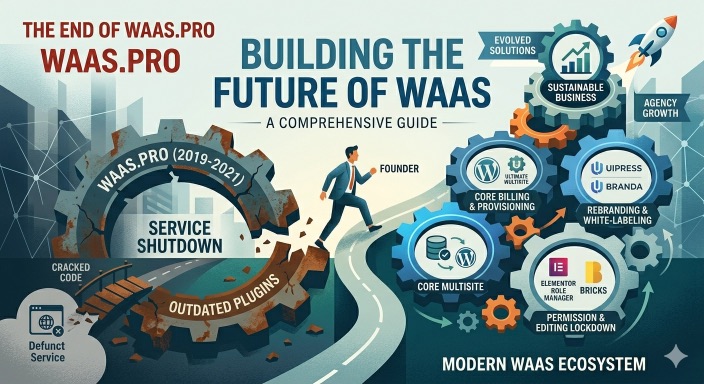
If you have been building or managing a "Website as a Service" (WaaS) platform on WordPress, you may have recently noticed that WaaS.pro (and its domain WaaS-Pro.com) has completely gone offline.
If you have been building or managing a “Website as a Service” (WaaS) platform on WordPress, you may have recently noticed that WaaS.pro (and its domain WaaS-Pro.com) has completely gone offline. Its premium suite of multi-functional white-label plugins—once a staple for network administrators—is no longer accessible or supported.
The good news? This was not a malicious “rug pull” or a sudden case of bankruptcy. Instead, it was a classic case of corporate acquisition and evolution within the WordPress ecosystem.
Here is the full story behind the shutdown of WaaS.pro, and exactly how you can migrate to a modern, future-proof alternative.
The core driving force behind WaaS.pro was Michael Short, a prominent entrepreneur who heavily popularized the WaaS concept between 2019 and 2021. He developed a highly specialized suite of white-label add-ons (including Admin UI PRO, Content Editor PRO, and Rebrand PRO) designed to tailor the WordPress Multisite experience for clients.
However, around 2021 to 2022, his trajectory shifted. Michael Short accepted a full-time executive role at GoWP—a major industry player providing white-label management and growth services for digital agencies. Tasked with hosting the GoWP podcast and scaling agency operations, he could no longer dedicate the massive time required to maintain a standalone plugin business.
During its peak, WaaS.pro existed primarily to patch features that core platforms lacked. Over time, the WordPress landscape rapidly changed:
Alongside the plugins, the site also hosted WaaS Camp, a premium educational bootcamp teaching agency owners how to launch and market their subscription platforms. As the founder integrated his expertise into GoWP’s ecosystem, the training material became outdated, and the independent sales domains were left to expire.
If your WordPress multisite network still relies on legacy WaaS.pro plugins, it is highly recommended to offload them before a future WordPress core update breaks your network.
Here is the modern, highly stable stack that top agencies use today:
The sunsetting of WaaS.pro is a natural reflection of how the WordPress ecosystem matures: fragmented, paid add-ons eventually get consolidated into superior core features or open-source solutions. By migrating your Multisite network to these modern alternatives, you will secure faster loading times, fewer plugin conflicts, and a much more reliable business model.
If you want to know how to safely deactivate legacy WaaS.pro code without breaking your live customer networks, or if you are looking for a specific alternative for one of their niche plugins, let me know your current setup below and I will guide you through the transition!